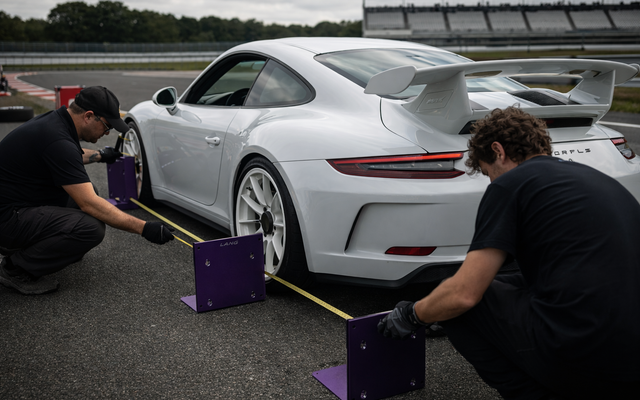
In the intensely competitive realm of today's serious oversteer competition, success is not merely exclusively a product of brute torque or behind-the-wheel courage. Rather, it has evolved into a intricate engineering challenge which necessitates a scrupulous fusion of selecting a inherently capable vehicle platform, outfitting it with the most precise drift-spec parts, and, most critically, understanding its dynamic behavior on the track through advanced vehicle dynamics analysis tools. This comprehensive handbook acts as your roadmap from the initial idea of a competition vehicle through to the last data-informed adjustments that transform a powerful machine into a consistent winner. We will delve deep into the art and science of car suspension tuning, showing how a advanced suspension tuning tool like GripDial eliminates approximation and offers exceptional visibility into your chassis's real-world behavior.
The cornerstone of any exceptional drift machine is, undoubtedly, the chassis itself. Certain platforms have achieved renowned standing within the worldwide sliding scene due to their inherent balance, durable design, and the immense range of aftermarket parts available. Choosing the right starting point is the initial and most significant choice a driver will make. For instance, the BMW's E36 3 Series is commonly accepted as one of the best all-around drift platforms of history. Its almost ideal balanced front-to-rear weight, combined with a RWD layout and bulletproof six-cylinder motors, forms a platform that is simultaneously accessible for beginners and highly capable in the control of a expert pilot. The successor of this lineage, the BMW E46, refines these qualities with a even more sophisticated chassis, increased stance for enhanced confidence, and yet increased turning capability as standard from the manufacturer. Another dominant platform in the top-level arena is the C6 generation Corvette.
This American track weapon introduces a unique set of strengths to the sideways world, including a lightweight aluminium frame, a transaxle-style gearbox and differential unit that contributes to an ideal balance, and the immense low-end power of a powerful GM LS engine. This combination renders it an utter force on track, able of entering and holding extended drifts with apparently effortless application of throttle. For drivers desiring outstanding bang-for-the-buck, the 350Z model Nissan stands out as a prime candidate. It comes from the factory with a stiff body structure, a competent factory locking differential, and the free-revving VQ35DE motor that offers ample performance for mastering and moving up in the activity. Its successor, the Nissan Z34, offers more advancements in structural rigidity, steering geometry, and overall engine power, cementing its status as a favorite selection among serious drivers. Additional legendary cars that deserve consideration are the nimble unique Mazda FC RX-7, the most popular S13 Silvia/240SX, the American Ford Mustang SN95, the more recent E90 3 Series, and the tiny yet unbelievably fun and instructive Mazda MX-5. Each of these cars offers a unique set of traits, complexities, and potentials, but they all have in common the core ingredients necessary to serve as a competitive drift car.
However, choosing the correct platform is just the starting point. To release the true capability of any of these machines, significant upgrades to the steering and suspension systems are utterly mandatory. This is where the world of precision aftermarket parts comes into sharp importance. The one most impactful upgrade for a dedicated competition vehicle is the integration of a high-performance drift angle kit. These sophisticated kits, such as those developed by specialist companies like SLR Speed, are engineered to radically enhance the car's available lock-to-lock rotation. A OEM road car is extremely constrained in how far its steering tires can rotate, a design trade-off for daily use. In sliding, but, aggressive countersteering is frequently needed to manage and sustain a drift. An modification kit replaces the stock hubs, tie rods, and sometimes A-arms with pieces that allow the wheels to reach steering lock over 70 or even 80 degrees, versus a average OEM angle of around 40 to 50 degrees.
This vastly greater capability offers the pilot with dramatically more authority during a slide, enabling it to be considerably more straightforward to initiate a oversteer moment, maintain it through a long turn, and transition smoothly from one direction to the opposite. The contrast in drivability is truly profound. Coupled with a correctly selected modification is the just as critical enhancement to the vehicle's suspension. Generic or including high-end street dampers are just not engineered for the unique and brutal demands of sliding. A purpose-built pair of adjustable dampers is paramount. These engineered dampers incorporate custom valving and spring strength that are designed for the rapid weight transfer that is characteristic of aggressive driving. When a driver begins a angle, the vehicle's mass is shifted rapidly to the front of the turn. Proper drift-spec dampers manage this movement in a predictable way, allowing the chassis to find its balance quickly and providing the driver precise feel through the controls and cockpit. They also allow for exact tuning of stance, damping firmness, and cross-weight, which are all fundamental elements of optimizing the chassis's handling to a specific track or piloting technique. In combination, a precision-engineered angle modification system and a properly chosen set of drift-spec coilovers form the undeniable physical foundation upon which all subsequent tuning is based.
Once the essential parts is fitted, the subsequent essential phase in the build is the detailed tuning of the car's wheel angles. This is the world of chassis dynamics adjustment, a procedure that can seem daunting to the beginner but is, in reality, the defining factor to converting a collection of capable components into a harmonious and consistent vehicle. The most critical element of suspension geometry for sliding is certainly camber. Camber angle is the inclination of the wheel relative to the perfectly straight axis when observed from the forward of the car. When the top of the tire is leaning inward, this is known as camber-in. For sliding, negative camber on the steering tires is universally applied and is regarded as essential. The purpose is fundamentally linked to physics.
When a vehicle is going around a bend at extreme sideways angles, the body tilts toward the outer of the turn. This chassis roll forces the outside front wheel to lose its ideal grip area with the tarmac. By applying negative camber, the wheel is pre-leaned to counteract this tilt. As the car rolls into the bend, the tire gains a better contact patch against the track, optimizing its grip at the precise time when it is needed most for steering authority. Usually, front angles for a competition drift car range from approximately -3 degrees to as high as -5 degrees or even beyond, depending on the details of the car geometry, tire selection, and pilot feel. The rear wheels also use inward lean, but the settings are generally more modest and more nuanced than the front axle. Excessive negative camber at the back can make the car excessively prone to oversteer and hard to predict on power application, as it shrinks the effective suspension engineering contact patch of the powered wheels during linear throttle application. Therefore, rear angles are frequently in the ballpark of -1 degree to -3 degrees, achieving a precise equilibrium between providing enough cornering grip to help in initiating and maintaining the slide while simultaneously keeping usable traction for power-down the corner. Camber is just one part of the broader suspension geometry picture, which also involves toe setting, caster, and bump steer adjustment.
Toe angle describes the direction of the tires as seen from the top. Inward toe means the front edges of the wheels are closer together than the rear edges, while toe-out means the opposite. For drifting, a small amount of front negative toe is commonly run to improve the initial response directional reaction, making the vehicle feel more nimble and willing to start a slide. Rear toe is generally set to zero or a incredibly minute amount of positive toe to encourage predictability under acceleration. Caster is the longitudinal or backwards tilt of the suspension pivot when looked at from the lateral of the chassis. Increased positive caster enhances self-centering and high-speed stability, and it furthermore boosts inward lean gain during cornering, which is extremely beneficial. Tuning these values is a complex interaction where a modification to a single parameter can and often will impact the others. The old-school process for tuning a car's suspension geometry for vehicle dynamics tool competition has historically been a tedious process of trial and error. A driver or crew would apply a change based on intuition, test the car on track, use the driver's personal feel and impressions, and then apply a further adjustment. This cycle would repeat again and again until the chassis felt "good" or the allotted practice time ended. This methodology is not only exceptionally inefficient in terms of man-hours and tires, fuel, and parts, but it is also deeply imprecise.
Driver feel is a notoriously inconsistent metric, influenced by countless elements such as fatigue, changing track grip levels, temperature, and merely the focus of the driver on that particular session. What feels "tail-happy" on one lap might feel "tight" on the subsequent lap, causing contradictory data and ineffective changes. This age-old problem in car suspension tuning is specifically where contemporary telemetry systems has stepped in to revolutionize the methodology.
The advent and adoption of sophisticated suspension tuning applications has brought about a radically different paradigm for tuning and optimizing high-performance drift machines. This new generation of tools, represented by groundbreaking solutions like data acquisition tools, operate by physically capturing the live mechanical behavior of the vehicle as it is being driven on the track. Unlike using driver feedback, these systems acquire quantifiable information on key parameters such as suspension travel, wheel speed, lateral and longitudinal g-forces, lock position, and driver input position. This collected data stream is then interpreted by sophisticated algorithms that can visualize and interpret the metrics in a comprehensible manner. For the very first time, tuners and builders can observe exactly what the chassis is exhibiting at any given millisecond of a lap. This ability transforms the complete alignment optimization process. Imagine the particular challenge of setting the front negative camber for a specific car. As an alternative to applying a change from -3 degrees to -3.5 degrees and then testing multiple passes to try and "sense" a improvement, a vehicle dynamics tool can provide real-time and irrefutable information. The application can indicate visually how the suspension's loading is behaving during the key phases of a angle: initiation, holding the angle, and switch. It can reveal if the current value is allowing the steering tire to maintain maximum loading or if the rubber is working inefficiently on its outer shoulder.
The system can subsequently suggest data-driven suggestions for adjustment. Perhaps the telemetry reveals that the tire is still overworking its outer shoulder at -3.5 degrees of camber, implying that even more inward lean, say -4 degrees, might be warranted. Conversely, the information might reveal that the tire is not reaching temperature or that the inside edge is wearing excessively, which could indicate that there is overly aggressive negative camber and a small decrease back to -3.2 degrees would be more optimal. This level of accuracy and practical analysis was simply unattainable in the days of exclusively seat-of-the-pants tuning.
The impact of using a advanced drift telemetry system extends far beyond just dialing in alignment. It functions as an essential coilover setup tips that is tailored to your specific vehicle. When fine-tuning the rebound and compression clickers on your suspension, rather than using vague advice or copying another driver's numbers, you can employ the software to analyze how the vehicle is performing in reaction to your adjustments. The software can show the suspension travel trace over a lap, revealing if the dampers are controlling the weight transfer optimally or if they are causing the vehicle to become unsettled uncontrollably after a flick. It can assist in identifying problems like hitting the bump stops or topping out, enabling you to make data-backed adjustments to preload settings, damping rates, or ride height. This approach extends just as well to the intricate task of suspension geometry optimization. Beyond camber, the software can give data into how changes to toe settings and caster angle are impacting the vehicle's handling during various maneuvers of a drift. For instance, it can assist you to determine the best amount of front axle toe-out for your individual angle kit configuration and driving approach by analyzing the speed of turn-in response and the predictability of the car at full countersteer. This turns the system an exceptionally effective drift suspension tuning guide that is constantly informed by the actual behavior of your own chassis on the circuit. It moves the complete process from a subjective skill into a methodical engineering process.
Furthermore, the value of a system like data acquisition is not confined to experienced engineers with vast funding. For the grassroots competitor, it acts as an amazing force multiplier. It practically provides the driver with the analysis of a professional suspension specialist without the typical cost. It speeds up the tuning process by giving definitive answers to problems that would normally take seasons of trial and error to solve. A driver can understand how their individual chassis reacts to specific inputs, developing a deeper comprehension of suspension theory in the journey. It also makes accessible professional suspension engineering concepts, enabling all drivers with the ambition to refine their vehicle to achieve it in a efficient and successful manner. This is especially valuable in a discipline like oversteer competition, where engineering knowledge has historically been a tightly held asset among professional crews. In the modern era, that knowledge can be in the hands of any serious driver.
In summary, the path suspension engineering to constructing and optimizing the ideal high-performance drift car is a multi-stage endeavor that seamlessly integrates classic mechanical principles with cutting-edge digital tools. It starts with the wise choice of a capable chassis, followed by the installation of critical performance components like maximum-angle drift angle kits and properly selected performance suspension units. The journey then progresses into the intricate realm of car suspension tuning, where parameters like negative camber, toe setting, and caster angle are carefully adjusted to match the chassis's upgraded geometry and the pilot's specific style. The final step, and what genuinely distinguishes the modern process from the traditional methods, is the adoption of a sophisticated drift telemetry software. This platform removes the guesswork and trial and error of solely subjective adjustment by delivering empirical, live data on how the car is actually functioning. It serves as an incredible diagnostic aid, a definitive alignment optimization handbook, and a comprehensive vehicle dynamics tool. In unison, this integrated methodology guarantees that all element of the drift car—from the pick of the chassis to the most minute click on the suspension—is refined for ultimate competitiveness on the competition venue. It embodies the full maturation of the sport of sliding, connecting physical car control with precise vehicle setup to build the perfect effective vehicles possible.